Welcome To Contact Us
Response Within 24 hours Guaranteed | Low MOQ from 50 pcs
🔒 100% Privacy Protected. No Spam Guaranteed.
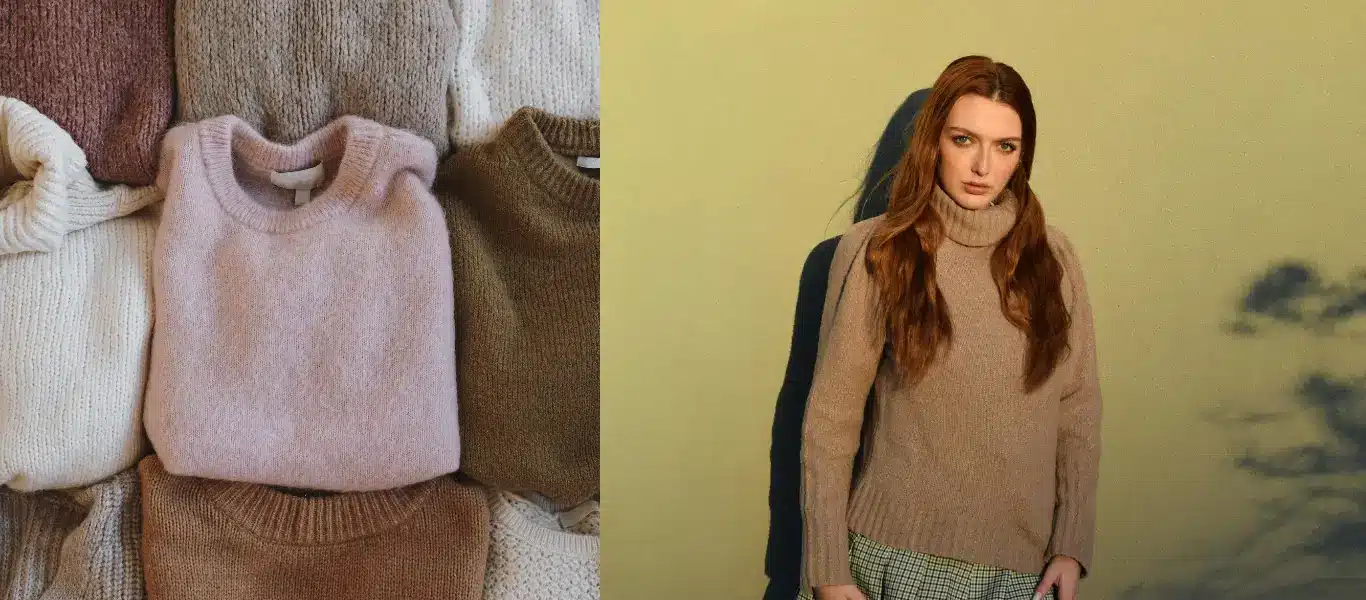
Sweaters, as the core asset for fall and winter closets, are not only about keeping warmth; sweaters are the direct presentation of personal taste and comfort. However, when facing so many fabrics on the market, like wool, cashmere, cotton, acrylic fabric, blended fabrics, and complex woven and craftsmanship, people are confused and don’t know how to pick one. As a custom manufacturer of winter hats and apparel, we, Aungwinter, are going to introduce how to pick the right sweater from these 5 aspects: fabrics, woven ways, sweater weights, silhouette details, and daily care. After knowing these, you won’t be confused about picking up your sweater anymore.
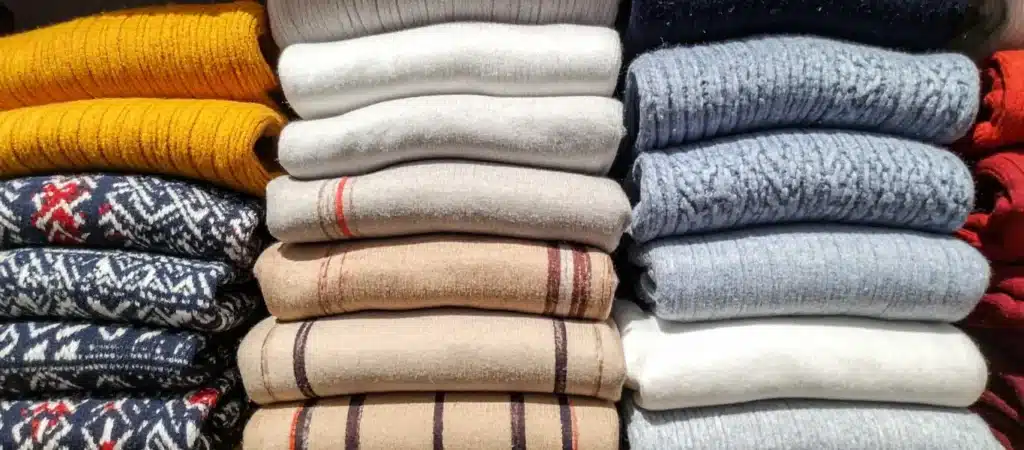
The key is to select the correct texture, and you’re 80% of the way to victory.
Textures are the soul of sweaters. Distinctive textures with distinctive properties can straightforwardly influence the warmth, comfort, pilling, and life expectancy of sweaters.
Highlights: A lean layer of down taken from the roots of goat hair; the fiber is exceptionally smooth. The weight of cashmere is as it were 1/5 of wool, but its warmth is 1.52 times that of wool, which is super close-fitting without tingling.
Applications: Suitable for making intimate garments and people who pursue extreme comfort, lightweight, and convenience, particularly for older, kids, and people with sensitive skin.
Selecting Tips: Look for the “Pure Cashmere” content label (items with over 95% cashmere may be designated as pure cashmere). The material should feel smooth, supple, and substantial to the touch – rather than dry or coarse. Be wary of low-priced cashmere (under 300 yuan), as it is almost certainly counterfeit; such items are typically blends or composed of inferior cashmere scraps.
Highlights: Conveyed from Merino fine-wool sheep, and the fiber separations over are underneath 19 micrometers (fiber breadth of common wool is nearly 24 micrometers), which is outstandingly fine and close-fitting without shivering. Other than, it’s magnificent at breathability, moisture-wicking, and controlling body temperature.
Application: Suitable for ordinary commutes, as the mid-layer for open air sports, and buyers who look for capacities and cost-effectiveness.
Cons: It’s more prone to getting wrinkles than cashmere, and the better the Merino wool, the less demanding to pill the Merino wool.
Selecting Tips: Check the “Super’s” count – for instance, Super 100’s. The bigger the number, the finer (and more expensive) the yarn. For an entry-level Merino wool sweater, you can find a good quality option for between 300 and 600 yuan in China (100-300 USD in the US).
Highlights: It’s the most common wool with coarse fibers, hard textures, and prickly sensations. Common wool has enough warmth, but the comfort is general.
Application: Suitable for outerwear, jackets, and budget-limited occasions.
Cons: With obviously prick sensation, and it’s prone to shrinking (if it has not undergone anti-shrinkage treatment).
Selecting Tips: Keep up a key remove from the misguided judgment that 100% fleece is unimaginable. If it’s not too much of an inconvenience, pay attention to the touching, common fleece sweaters with awesome adaptability are perfect. In expansion, it’s crucial to check the care title to ensure it unequivocally states “machine wash” or “shrink-resistant.” For standard fleece sweaters, a fetched run of 200 to 400 yuan (50-200 USD) is considered sensible.
Pure cotton: Soft, breathable, and does not cause static electricity, but it’s poor at keeping warmth, and it’s easy to deform, which is suitable for spring and autumn, and rooms with air conditioners.
Blended silk (wool +silk): Enhancing the luster and smoothness of sweaters, with nice dropping, but needs careful wash and care.
Linen: Cool, breathable, moisture-wicking, but sweaters made of pure linen are extremely rare; most are linen-cotton blended fabrics, which tends to be highly stylized but offer low comfort.
Highlights: The outer appearance mimics wool, and they are warm, breathable, and poor at skin-friendly. The biggest pros are cheap, not easy to pill, and deform.
How to Tell: It feels slippery and has a “plastic-like” texture; burning it produces black smoke and leaves behind hard lumps; and it generates significant static electricity.
Purchasing Advice: It is not recommended to buy sweaters containing more than 30% acrylic if you intend to use them as thermal wear. If a garment is labeled “100% Acrylic” or “Faux Cashmere,” it is a synthetic fiber – not wool.
| Needed Scenarios | Primary Choices | RecommendedContent | Referring Budget |
| Close-fitting bottoming outfits; sensitive to tickling. | Merino Wool/Cashmere | ≥95% | ¥400-1500+ in China $300+ in the USA |
| For Styling with Easy Care | High-end Blended Acrylic and Wool (20% Wool + Acrylic) | ≥20% Wool | ¥200-400 in China $50-100 in the US |
| Outdoors and Mid-layer Sports Wear | Merino Wool | 100% | ¥500-1000 in China $200+ in the USA |
| Limited Budgets | Common Wool – Avoid Intimate Outfits | ≥50% wool + blended fabrics | ¥150-300 in China $50-100 in the USA |
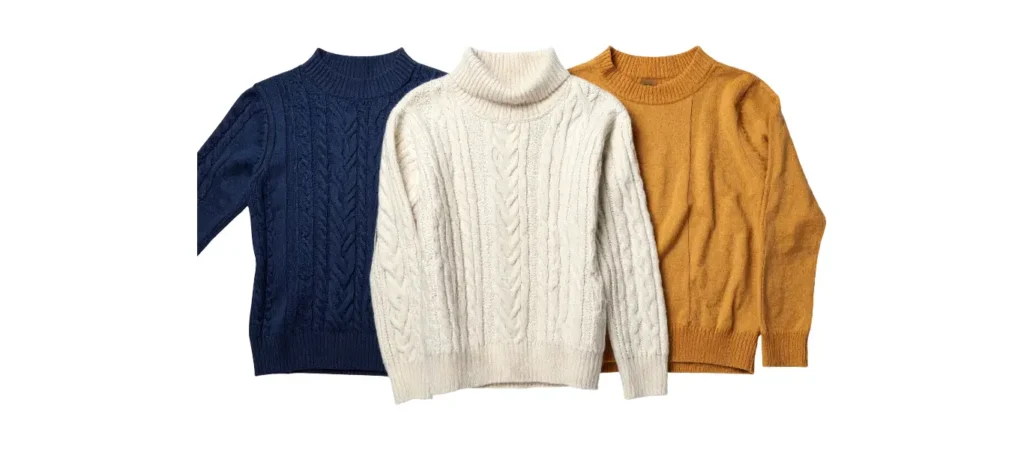
Same fabrics are used in different weave ways, making sweaters look totally different, which seems like two different outfits.
Advantages:
Limitations:
Common Use: Widely used in business-casual and smart everyday styles.
2. Chunky Knit: Characterized by large, visible stitches with a thick and lofty texture.
Advantages:
Limitations:
3. Rib Knit: Defined by vertical ribbed textures with high elasticity.
Advantages:
Style Note: Full ribbed garments create a slimming, fitted silhouette.
4. Cable Knit: Features raised, twisted patterns resembling braided ropes.
Advantages:
Limitations:
“Weight” refers to the total weight of a size M sweater, which directly indicates its thickness and warmth.
Under 200g – Ultra-Lightweight
200–350g – Standard Weight
350–500g – Mid-Heavy Weight
500g+ – Heavyweight Knit
Always evaluate fabric composition alongside weight for a more accurate understanding of warmth and performance.
Detail is the devil, and a real sweater tells from 3 details – neckline, shoulder stitching, rib, and hem.
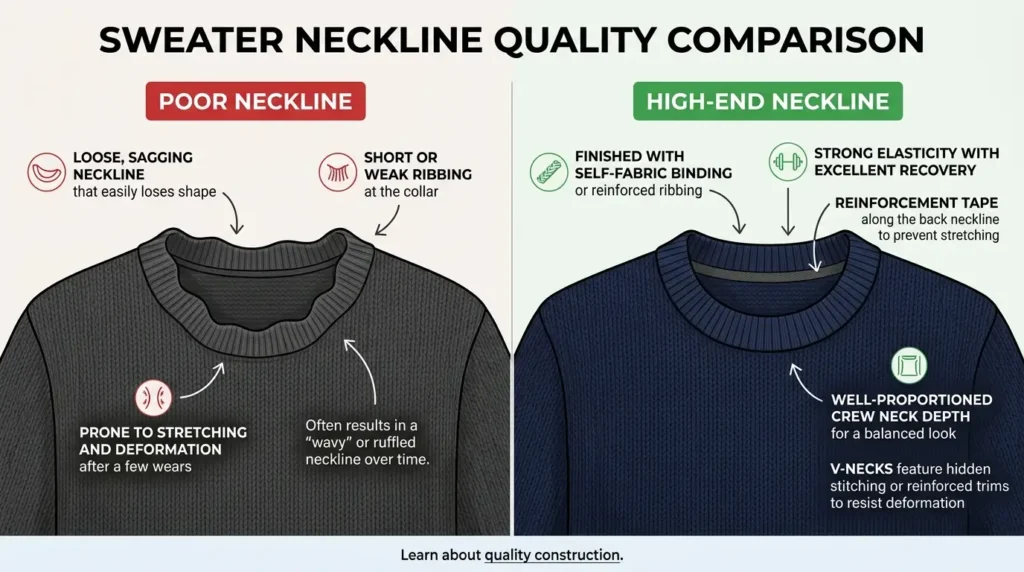
Poor Neckline
Often results in a “wavy” or ruffled neckline over time.
High-end Neckline
Poor stitching: Basic single-needle stitching (straight seams) leading to stiffness and bulk, especially under the arms. Poorly executed drop shoulders, causing twisting or diagonal distortion (skewing). Uneven seam finishing with messy, overlocked threads. Results in discomfort, poor drape, and visible deformation.
Quality and high-end shoulder stitching:
How to check:
Inside seams show a clean, chain-like structure → high quality
Messy, dense overlock stitching → lower quality
Length standard: Cuffs and hems should have ribbing no shorter than 3 cm/1.18 inches. Short ribbing tends to curl or lose shape easily.
Elasticity test: Stretch the ribbing and release.
Good quality: snaps back quickly with no color fading.
Poor quality: turns whitish when stretched (indicates weak or low elastic fiber content).
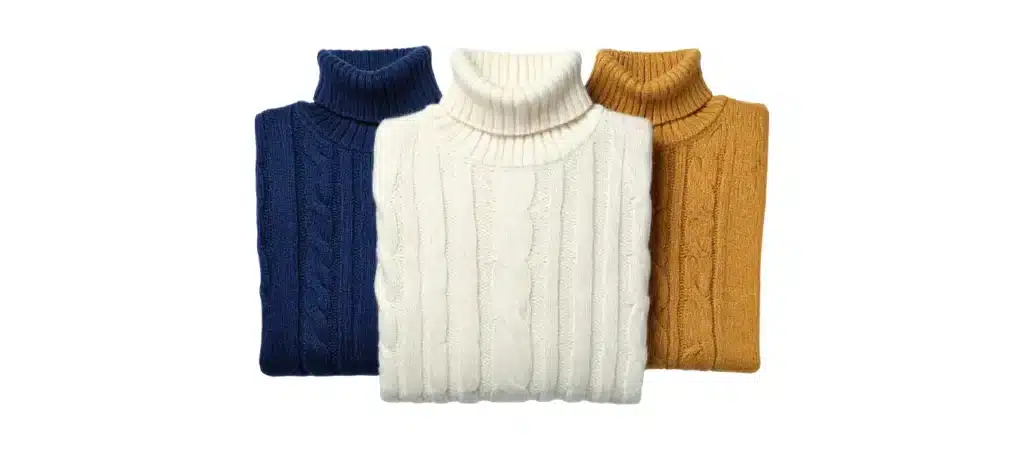
High-neck sweaters are temperamental because they can cover necklines, so they can obviously show our facial features and contours. High-neck sweaters are temperamental because they can cover necklines, so they can obviously show our facial features and contours. For individuals who have a petite, favor, or formed figure, turtle-neck sweaters are their to begin with choice. Be that as it may, for individuals who have a circular face or a brief neck, they must maintain a strategic distance from choosing a High-neck sweater; something else, such a sweater can make their confront see greater without a neck, making them appear shorter. Subsequently, individuals with a circular face or a brief neck, if you don’t mind, think twice some time recently choosing such a High-neck sweater.
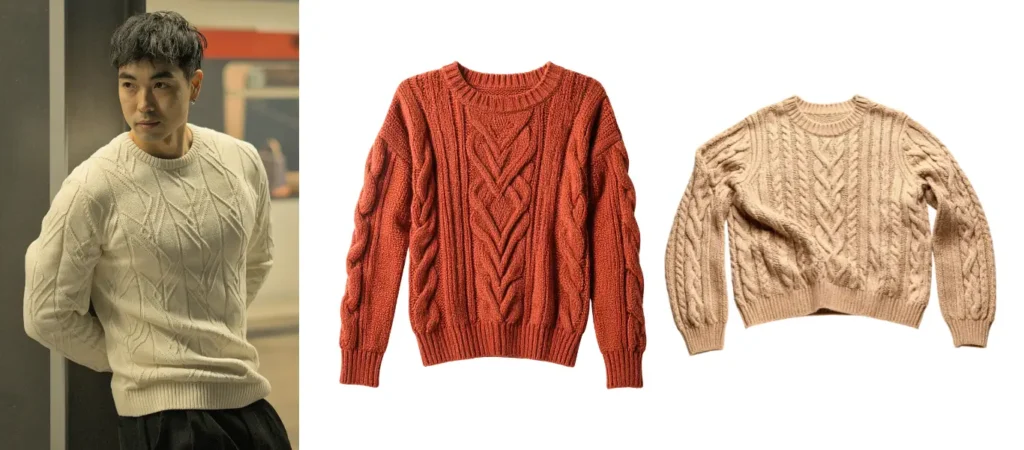
Round neck sweaters are the most common style among all sweaters, and almost people have one, which is fashionable yet versatile. Moreover, round neck sweaters are not picky about face shapes and body curves. Besides that, slim round neck sweaters cannot only accentuate the curves of the upper body but also highlight a slender neckline, creating a visually elongating effect. It is an ideal choice for middle-aged women in their 40s and 50s, serving equally well whether worn on its own or layered.
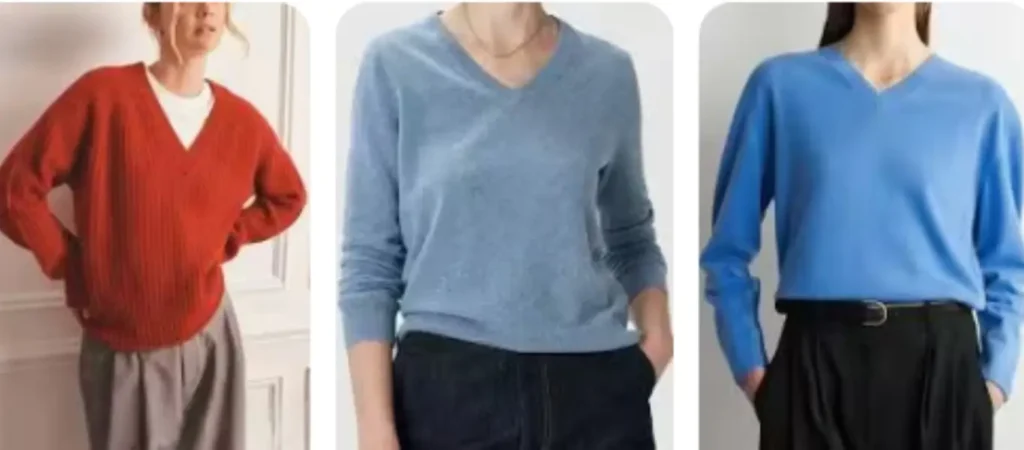
There is no doubt that V-neck sweaters are the most feminine. V-neck sweaters can be worn on their own or as an inner layer. They can modify face shapes and inadvertently show fancy clavicles at the same time, full of feminine sense. Besides fashionable yet versatile features without losing femininity, V-neck sweaters don’t have a limit on face shapes and body curves. For example, women with a round/square/rectangle face can easily master a V-neck sweater.
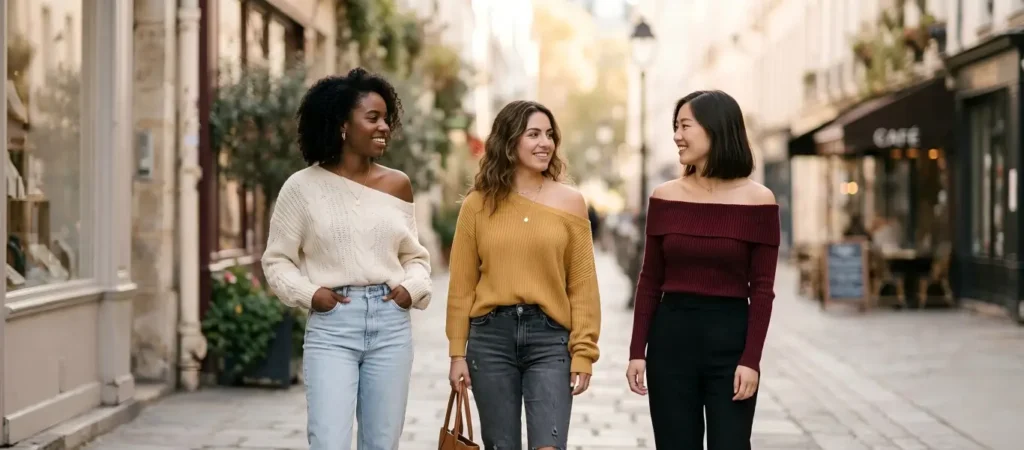
Straight bear lines at that point appear them off unquestionably by means of off-the-shoulder sweaters. With clean, precise lines and slim forms, the shoulders and neck take on an indeed more exquisite and sensitive look when wearing an off-the-shoulder sweater. For petite ladies with a fragile outline, this shoulder-baring fashion oozes an especially tender charm; it is additionally a complementary choice for those with a smaller bust, offering a look that’s both chic and advanced.
There are 3 sorts of Polo sweaters – button Polo sweaters, zip-up Polo sweaters, and classic Polo sweaters without buttons and zips. Button Polo sweaters are full of a sense of age, full of vintage feeling; zip-up Polo sweaters are much more in vogue, which is youth-enhancing; classic Polo sweaters without buttons and zips have a solid sense of French casual fashion.
Sweaters made from animals’ hair pill anyways, including the most expensive cashmere. The pilling is determined by fiber features – short fibers will pill after friction.
Easy to Pill: Woolen-spun yarns, low yarn count, high short-fiber content, and loose knitting structure (chunky knits).
Hard to Pill: Worsted-spun yarns, long-stable fibers (like high yarn count Merino wool and quality cashmere), fine dense knitting, and smooth surface finish.
The Right Way
1. Focus on flat detail images like clear necklines, armpits, and stitching, rather than model styling shots. Please ask customer service 3 questions:
“What is the fabric weight of this garment?”
“Is the stitching method linking or flat-seaming?”
“Were the different colors dyed in the same batch?”(Ask this if you are sensitive to color variations.)
2. Check the follow-up reviews: See whether the item shrinks, loses its shape, or sheds excessively after washing.
3. Prioritize listings that offer shipping insurance. Upon receipt, immediately perform a “hanging test” – hang the garment on a hanger for 24 hours to observe whether the shoulders or hem stretch out right away.
Buying well matters, caring better matters more.
Avoid:
Machine wash only if labeled machine washable, and always use a laundry bag + wool/delicate cycle.
2. Drying
Do not hang – water weight can stretch and distort the garment
3. Storage
Place cedar wood blocks or moth repellents in the wardrobe.
Do not let them come into direct contact with the sweater.
4. De-pilling
| Your Core Demands | Choosing Fabric & Structure | Acceptable Price |
| Sensitive skin Needed extreme comfort | 100%Cashmere and fine knitting Weight: 200 – 300g | ¥1000-3000 $150-500 |
| Wear resistance at least lasting for 3 seasons | 100% Merino wool (fiber breadth is below 19 micrometers), Medium thickness, and tidy stitching | ¥400-800 $60-150 |
| For sweater silhouette not for close-fitting | 50% Common wool – coarse-knit or cable knit, may feel slightly prickly. | ¥200-500 $30-100 |
| Sweaters don’t need care | 80% Acrylic +20% wool blend, pay attention to silhouette | ¥150-300 $20-60 |
| For outdoors and sports | 100% Merino wool – Functional sportswear (Care labels feature UPF and Quick-Dry symbols) | ¥600-1200 $90-200 |
One final piece of advice: sweaters belong to a category where personal experience matters far more than price-to-value ratio. Do not expect the quality of wool at the price point of synthetic fibers, nor should you – out of vanity – purchase a cashmere piece that fits poorly and that you are too reluctant to actually wear. In your budget, if it’s not too much trouble, select the most comfortable texture, the foremost timeless fashion, and the best-fitting cut – that’s the definition of the culminate sweater.
We trust this direct makes a difference, you remain warm, see cleaned, and have no laments around your closet choices this winter.
Sweater Materials & Difference Between Sweaters, Sweatshirts, and Knitwear