Welcome To Contact Us
Response Within 24 hours Guaranteed | Low MOQ from 50 pcs
🔒 100% Privacy Protected. No Spam Guaranteed.

First of all: don’t judge clothes only by fiber.
Even if both are made of cotton, a shirt and a T-shirt feel completely different.
What really affects fit and comfort is: is it woven or knit?
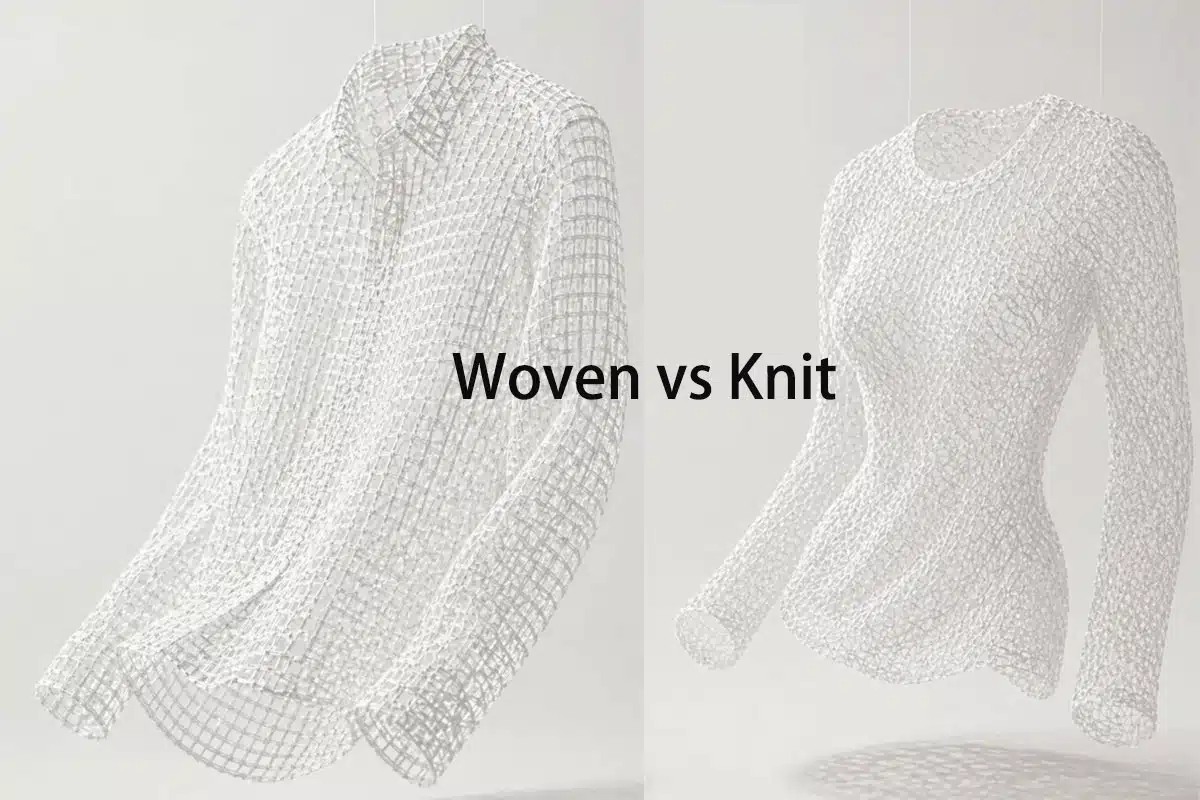
Fabrics are mainly divided by construction into two types: woven and knit.
Woven fabric is made by interlacing two sets of yarns:
warp yarns run vertically, and weft yarns run horizontally.
They cross each other to form a stable structure.

Key features of woven fabrics:
Common woven items:
Style keywords:
Sharp, structured, polished
Knit fabric is made by looping yarns and connecting those loops together.

Key features of knit fabrics:
Common knit items:
Style keywords:
Soft, close-fitting, relaxed
Simple analogy:
Woven = like a “crossroad grid”
Knit = like “oops in a sweater”
Woven: grid, plain weave, twill (diagonal lines)
Knit: visible loops, like tiny braids or sweater stitches
Hard to stretch, little bounce back → likely woven
Easy to stretch and recovers → likely knit
⚠️ Note:
Some woven fabrics contain elastane, so they can stretch.
Some knit fabrics are tightly made and feel stable.
Don’t rely on stretch alone.
Shirts, suits, trench coats, jeans → mostly woven
T-shirts, hoodies, sweaters → mostly knit
Woven: “creates shape”
Knit: “follows your body”
| Feature | Woven Fabric | Knit Fabric |
| Construction | Interlaced warp and weft yarns | Interlocked loops of yarn |
| Structure | Stable and firm | Flexible and elastic |
| Stretch | Low (unless elastane is added) | Naturally high |
| Texture | Grid, plain weave, twill patterns | Loop or braid-like appearance |
| Comfort | Structured, can vary by material | Soft, comfortable, body-hugging |
| Shape Retention | Strong, holds shape well | Moderate, may relax over time |
| Common Uses | Shirts, suits, denim, outerwear | T-shirts, sweaters, activewear |
| Style Impression | Clean, sharp, professional | Relaxed, soft, casual |
1.Business or formal wear:
Choose woven. It looks cleaner, sharper, and more structured.
2.Daily wear, home, sports, layering:
Choose knit. It’s softer, more flexible, and more comfortable.
“Woven is always uncomfortable” ❌
High-quality cotton shirts, Tencel, silk, and linen can be very comfortable.
“Stretch = knit” ❌
Many woven fabrics now include elastane for stretch.
“Thicker = better quality” ❌
Thickness only means higher weight, not better quality.
Quality depends more on yarn, density, and construction.
Clothing quality is not just about fabric.
It’ the result of yarn, structure, craftsmanship, and how it feels on your body.