お問い合わせへようこそ
24時間以内の返信保証 | 最低発注数量50個から
🔒 100% プライバシー保護済み。スパムメールは一切届きません。.
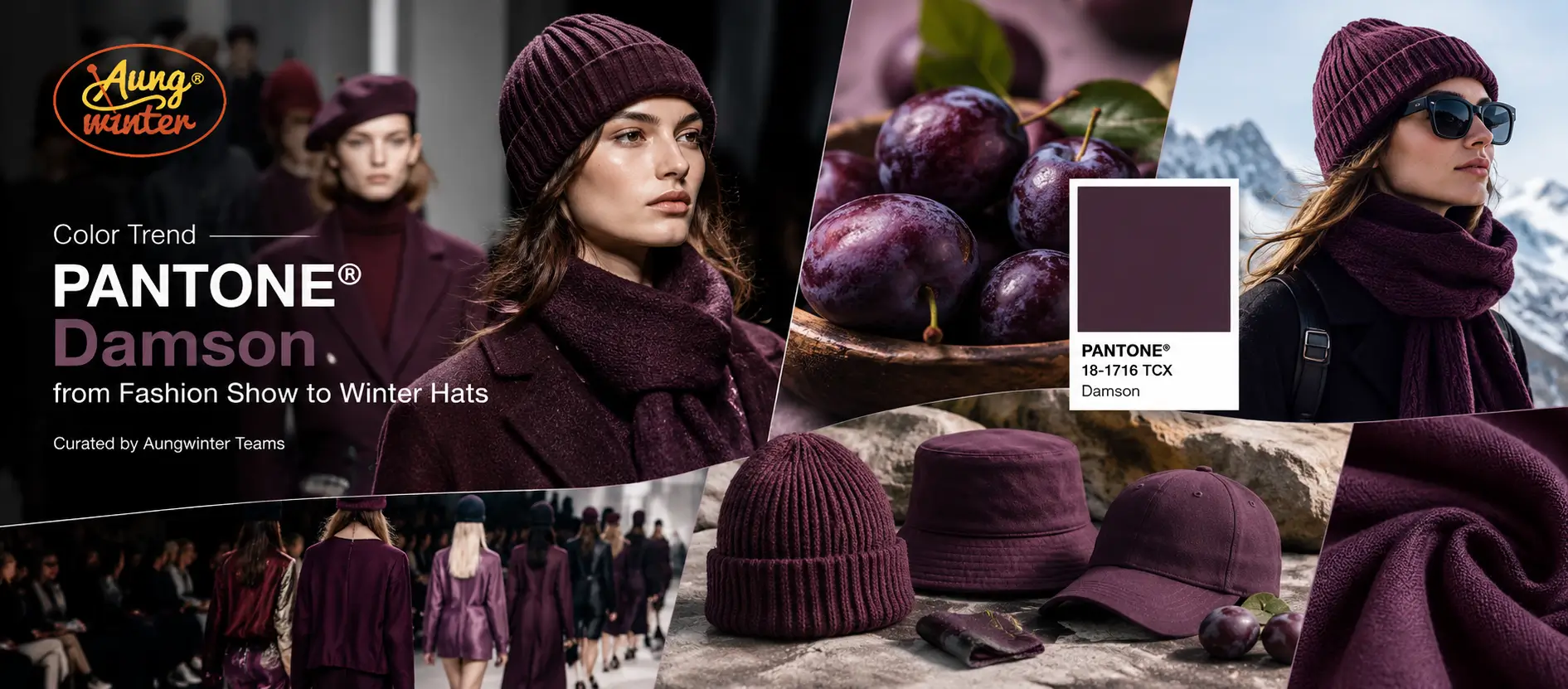
Curated by Aungwinter Teams
As a professional manufacturer of winter hats, we, Aungwinter, have focused on global color trends that can deeply affect fabric sourcing, product development, and brand sourcing strategies. In 2025/2026 fall and winter, PANTONE® launched the color PANTONE® 18-1716 TCX Damson. Due to its unique charm of fruit aromas and a wooden, saturated purple, Damson is becoming trendy so fast, resulting to be seen frequently on international runways in London, Milan, and more, from high-end ready-to-wear and accessories.
For winter hats, in this hat segment, color is never a visual problem because it can directly affect fabric choices, dyeing, and warehouse strategies. The coming up of Damson offers a choice for winter hat manufacturers and brands – a color choice that combines differences and business safety. Here, we will start from our perspective as a B2B winter hat manufacturer to explore why damson is a great choice for winter hat manufacturers and brands.
In this part, we will go through color tone and trends to analyze why Damson has special commercial suitability for business in the winter hat segment. Understanding the sense behind color, consumers’ emotions, and supply chain signals is the base to fabric choices and product development strategies.

Damson is not a traditional saturated purple color, but its core tone is purple, blending with red-brown and soft grayish tones to create a low-saturation matte color, which has a special meaning for winter hats.

Purple tones account for 5.9% of 2026 fall and winter women’s wear. What’s more, the use of Damson in brand fashion shows like Michael Kors and Chloé is increasing by 37%. Here is the inspiration from these data for B2B winter hat sourcing.
1.Upstream fabric suppliers – responding: In general, the color trend of fashion shows will be delayed by 1 – 2 months from runways to fabric suppliers. Therefore, now is the window for Damson fabric choices and locking in orders in advance.
2.Color testing grounds – accessories: Usually, brands are very cautious about using new colors in garments, but accessories like hats, scarves, and gloves are a highly perceptive entrance of testing new colors with lower risk. Damson winter hats can be a testing color anchor spot for brands’ fall and winter collections, which can be complementary to same color-toned coats or neutral-colored jackets.
This part, we will go through the implementation pathway for Damson – from color swatch to finished product-covering fabric selection, key control points in the dyeing process, and product assortment recommendations based on styling logic. For B2B customization, the core of successful color realization lies in the precise alignment of materials and processes, rather than a mere pursuit of exact color code matching.

| Fabric Types | Damson Textures | 最高 | Dyeing Notes |
| Blended Wool(wool + nylon) | Matte texture, emphasizing grayish tones, with a high-level sense. | Knitted hats and berets | Color fastness must be controlled; wool has high dye absorbency and tends to take on a darker shade. |
| Cashmere or Blended カシミア | Tender colors with a natural luster and the highest-level sense. | High-end knitted hats and pompom beanies | It’s challenging to control color difference; pre-approval of color samples is recommended. |
| Acrylic or Chemical Fibers | High-saturation colors with controllable costs. | Basic knitted hats | Adding a matting agent can reduce the plastic-like appearance. |
| Short-Pile Wool or Wool Felt | A strong sense of three dimensions, weakening grayish tones, and enhancing the red-brown tone. | Formal hats and bucket hats | The felting process is prone to color deviation, requiring repeated color matching. |

Damson’s low-saturation, matte finish requires higher dyeing accuracy.
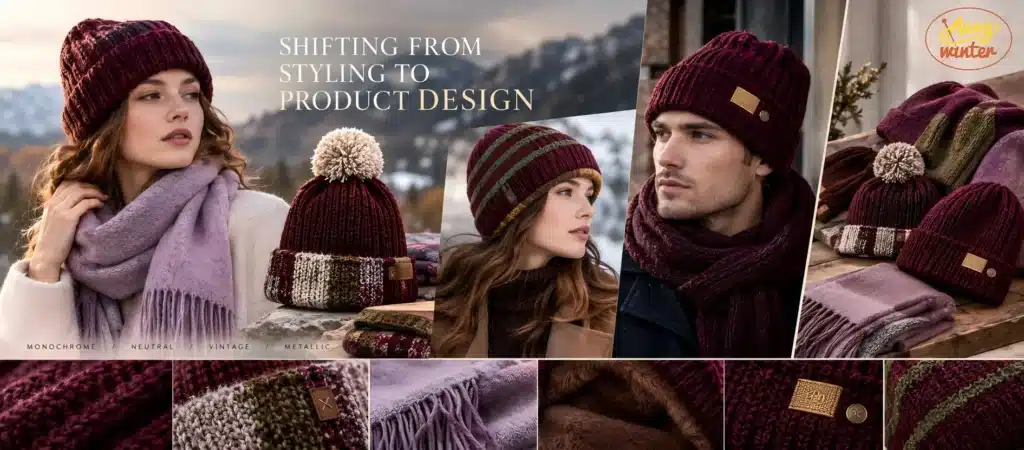
For B2B clients, here are our product combination suggestions based on Damson’s color coordination logic:

In this part, we will talk from a sourcing strategy perspective to analyze onboarding strategies, minimum order quantities, and cost structures for different client types, as well as contingency plans for inventory risks associated with trending colors. The commercial value of trending colors goes hand in hand with inventory risks; therefore, rational planning is much more important than directly following the trend.
| Client Types | Suggestion | Logic |
| Online DTC Brands | Primary to adopt | Visual differentiation is the core to getting more consumers, and popular colors can lower the marketing cost. |
| Off-line Boutique/ Buyer Shops | Testing with small batches | The customer base is sensitive to color, yet inventory risk must be managed. |
| Fast Fashion | Starting with an accessories capsule collection | Low unit price and high turnover enable rapid validation of market response. |
| Corporate Bulk Purchase / Gift Channels | Cautious to use | Popular colors are personalized, which might lead to aesthetic differences between traditional group buying. |
For custom Damson winter hats, we, Aungwinter, suggest that clients have a look at the parameters below.
Minimum Order Quantities (MOQ): Generally, the MOQ for regular knitted beanies is 300 pieces, and the MOQ for wool felt hats is 200 pieces. We suggest keeping the first order of popular colors at 1.5 to 2 times the MOQ, and it should not be too radical.
Sampling Lead Time: Including dyeing and color matching; color sample approval is expected to take 7-10 working days. Please allocate sufficient time for this within the product selection schedule.
Cost Impact: The matte finishing and color fastness requirements for “Damson” are slightly higher than those for standard colors, resulting in an estimated cost increase of 3%-5%. However, this can be offset through economies of scale.

The popularity of specific colors is subject to uncertainty regarding their lifecycle. It is recommended that clients, while introducing “Damson,” also stock one or two “safe alternative colors” with similar hues (such as deep grape purple or grayish-purple brown); this allows for a quick switch should end-market feedback fall short of expectations, thereby minimizing inventory losses.
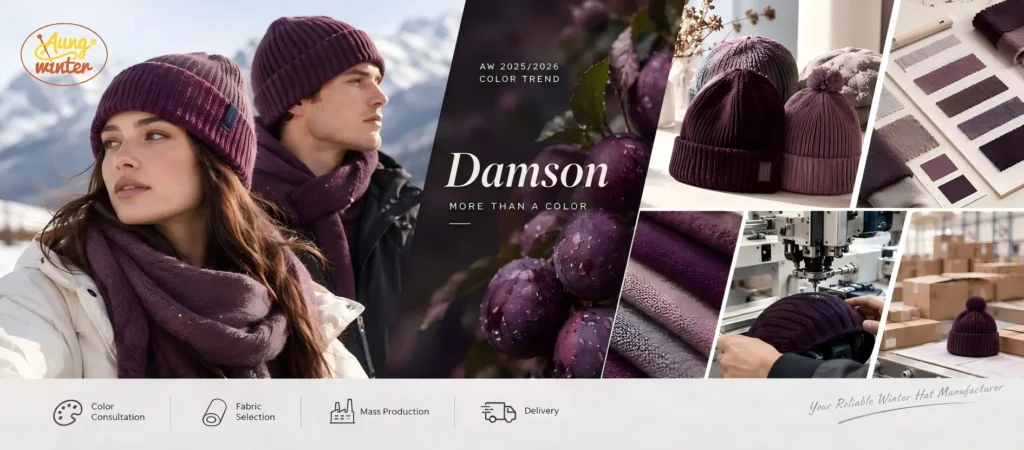
The rise of Damson is not an accident or isolated, and it proves the deep logic that fashion trends have turned into texture and emotional resonance. For winter hat manufacturers and brand sourcing, understanding a trendy color is not only about knowing the color code, but also about understanding consumers’ emotions, fabric logic, and supplier chains behind the color.
We, Aungwinter, will continuously follow the implementation of Autumn/Winter 2025/2026 color trends in terms of fabrics and craftsmanship, providing B2B clients with a one-stop customization service that spans everything from color consultation and fabric selection to mass production and delivery. If you are planning a procurement strategy for winter hats in “Damson,” please contact our color consultancy team to receive exclusive fabric color swatches and cost estimates.
A: Yes, Damson has different textures on different fabrics, so this is a must-have point to consider when ordering custom Damson winter hats. Damson on wool blends emphasizes grayish, matte textures; for cashmere, Damson has a softer, more natural luster; for acrylic or chemical fiber, Damson has a high-saturation, pop purple texture. Therefore, to keep the color consistency, we suggest using PANTONE® 18-1716 TCX Damson as the base color to accuracy dyeing samples which can ensure the actual fabric textures.
A: For standard knit styles – such as the classic chunky knit beanie – the MOQ for Damson is 300 pieces per color. For wool felt hat styles, it’s 200 pieces per color. We understand that startup brands and boutique buyers often need to test the market with smaller batches. That’s why we offer a shared dye‑bath production option: multiple clients share the same dye vat, and once the combined MOQ is met, each receives their own smaller batch. Please contact our sales team to confirm availability and scheduling for shared-dye runs.
A: Damson is a medium‑low saturation color, so colorfastness is critical. We use reactive dyes plus a fixing treatment on wool blends and acrylics, achieving Grade 4+ under ISO 105‑C06 – enough for daily wear and wet weather. Just keep in mind: dark hats can transfer a bit of color onto light clothing at first, so we suggest adding a care label note: “Wash separately before first wear.”
A: Damson has a cross-gender appeal thanks to its age‑less, all-skin-tone-friendly nature. That said, it’s still mostly a women’s color in the market. For men’s hats, we suggest using it as an accent – stripes, lining, or a pompom – rather than a full block of color. For a more neutral or youth-focused audience (streetwear, vintage brands), a unisex full-color version with metal hardware can work well and adds a touch of edge.
A: Both are low-saturation, emotional colors, but they work differently. Ancora Red feels warm and cozy; Damson feels more reserved and individual. Risk-wise, Damson has a slightly smaller audience than Ancora Red, but it stands out more from competitors. We suggest starting with 60-70% of your Ancora Red first-order volume, and keeping grayish purple-brown on hand as a backup color to avoid overstock.
A: To keep the look cohesive, start with a base of warm gray, off-white, or oatmeal – these create a gentle, layered transition with Damson. For hangtags, matte card stock works beautifully, and you can print in deep purple‑brown or warm grayish brown. Just steer clear of loud, high-contrast colors, since they can overpower Damson’s quiet character. And if you’re thinking about metallic accents, matte gold foil is the best match.
A: Standard timeline: color sample approval takes 7-10 business days, bulk production takes 25-35 business days (depending on style complexity), and QC/packaging takes 3-5 business days. Total: about 35-50 business days. During peak season (Sept–Nov), it can take longer. So we suggest finishing sample approval by June – July and locking in bulk orders by mid-August; that way, you’re ready for the autumn/winter sales rush.
A: Absolutely – and it’s one of the most commercially valuable applications under current runway trends. Common Damson combinations include:
A: Flexibility is high before the fabric is cut and sewn – that is, while the material is still at the yarn or fabric stage. Once cutting and sewing begin, the cost of changing colors rises significantly. For this reason, Aungwinter recommends a phased decision-making model: the first order confirms only fabric dyeing and yarn reserves, while hat cutting and sewing are postponed until after pre-sale or trade show feedback. For knitted panel styles, keeping panels unsewn preserves approximately 30 – 40% flexibility for design adjustments – such as changing crown decorations or modifying the hat shape. This strategy can reduce the trial-and-error cost of trend colors by about 40%.