
Winter shirts are essential transferred pieces between business and casual scenarios, and the fabrics of winter shirts can directly affect their competitiveness and popularity on the market. Here we, Aungwinter – a reliable custom manufacturer of beanies, winter hats, and apparel – will provide solutions for winter apparel factories based on fabric features, market data, and international trends, which helps enterprises to find their accurate position on the market.
1. Market-Driven – The Orientation of Winter Shirt Demands & Technological Evolution
① Changes in Product Structure Amidst Consumption Upgrading
Data from the 2024 China shirt market, men’s shirts account for 59%, including winter thick shirts higher 12% than summer thin shirts. From the online channels, “wrinkle-resistant”, “warm”, and “ironing-free” are hot-searching words. The “Lao Meng Shirts” livestream on Douyin (Chinese version) sold over 2,000 pieces in a single week, with its core selling point being the “double-ply cotton, machine-washable, wrinkle-free” technology. This has shown that function has become the basic demand for winter shirts, and fabrics are the carrier to achieve their core functions.
② Different Demands for International Markets
The China Customs data showed that the exported shirts increased by 5.7% from January to August in 2025, but the average unit price was lower by 6.9%, which presents an increase in sales but a decrease in unit prices. In contrast, exports to the EU grew by 6.7% against the trend, including high-end cashmere shirts that are over $35 per piece. The premium price is 42% than common cotton shirts. The EU and US markets are willing to pay for high-end fabrics (like 10% cashmere blend fabrics), which provide enterprises a clear orientation for product updating.
2. The Core Fabric Technical Parameters Comparison & Selection Strategy

1. Double-ply Cotton – Primary Choice for Formal Scenario
- Physical Features: Double-ply cotton is twisted together from two single yarns, the tensile strength increased by 30% with a wrinkle recovery angle reaching 120° (compared to 95° for single-ply cotton), which is compliant with ISO 13941.1. In a -5°C/23℉ environmental chamber test, 21 double-ply cotton achieved a CLO value of 0.6, demonstrating a 25% improvement in heat retention compared to single-ply cotton fabrics of the same yarn count.
- Market Validation: Youngor Group’s production of double-ply shirts increased by 18% in 2024, and GAZE (The General Association of Zhejiang Entrepreneurs) accounted for over 60%. Therefore, it’s suggested that winter shirt factories primarily manufacture 21 to 40 double-ply cotton shirts, which combine structure and comfort, suitable for business and formal occasions.
2. Textured Flannel – Breaking Through Casual Scenarios
- Innovative Craftsmanship: Flannel produced through the “14-grip, 2-cut” raising process achieves a pile density of up to 12,000 fibers per square centimeter, which can form a stable air-insulated layer (compared to 8,000 fibers per square centimeter for standard flannel). The OWN DREAM Winter Warm Pro series achieves a thermal rating of 0.8 CLO through this process, reducing weight by 30% compared to traditional flannel.
- Insights of Trends: The European American vintage trend has pushed the annual sales of corduroy shirts up to 22%. ESHK washed corduroy shirts are sold 12,000 pieces per month on the TianMao(Chinese online shopping App), despite a unit price of 75.6 yuan, it maintains a high repurchase rate. Manufacturers can develop heavy flannel fabrics weighing 600-800g/m², balancing warmth and softness through a brushing process.
3. Blended Cashmere – Positioning in the High-end Market
- The Golden Ratio Blend: 10% Cashmere + 90% blended cotton. This gold ratio blends 10% cashmere and 90% blended cotton, which can maintain the moisture absorption and breathability of cotton (moisture regain rate of 8.5%), and can lower thermal conductivity by 0.032 W/m·K (compared to 0.04 W/m·K for pure cotton). According to Data from the National Textile Products Quality Inspection Center, this blended proportion decreases the cost of cashmere by 60% and keeps the 85% warmth compared to pure cashmere.
- Example Cases: Loro Piana launched Cashfur blended shirts, containing 15% goat cashmere, with a unit price is EUR 280 per piece in the Euro-US high-end market. The Q3 sales grew by 19% year-on-year in 2025. Therefore, it’s suggested that apparel manufacturers use 16-24 count cashmere-cotton blend yarns, targeting duty-free markets in RCEP member countries to circumvent tariff barriers in Europe and the United States.
3. Quantitative Models for Production Decisions: From Laboratory to Market
① Cost-Performance Tradeoff Matrix
| Fabrics | Cost(yuan/meter) | Warmth(CLO Index) | Target Markets | Cross Margin Space |
| Double-ply Cotton | 35-45 | 0.5-0.7 | Domestic Business Suits | 35-45% |
| Heavy Flannel | 55-70 | 0.7-0.9 | Euro-US retro fashion trends | 45-55% |
| Blended Cashmere | 80-120 | 0.9-1.1 | Luxury Goods/Cross-Border E-Commerce | 60-75% |
② Innovative Technology Direction
- Intellectual Temperature Control: Shirts with embedded graphene heating modules can raise body temperature to 1.8℃/34.7℉ in environments as cold as -10℃/14℉. OWN DREAM Winter Warm Max Series is equipped with this technology, and has achieved an achievement, selling 90,000 pieces in 7 days.
- Sustainable Certificate: Shirts made from certified organic cotton can enter Walmart and other retailers through fast green channels. By 2025, the global sustainable organic products market share will have reached 34%.
- Flexible Production: By integrating with 3D virtual fitting systems (such as Coding AI Fitting Room), return rates have been reduced from the industry average of 15% to below 5%, significantly lowering inventory risks.
4. International Market Strategy: Data-Driven Rationalization Solutions
① Fabric Preference on the Exported Market
- European Union: Fabrics that are certificated with Eco-label have annually increased by 27%; the tariffs of 10% blended cashmere shirts have been decreased to 0 according to the RCEP Agreement (Regional Comprehensive Economic Partnership).
- The United States: There is a 3% customs discount for shirts made from regenerated fabrics. Thus, it’s suggested to manufacture shirts from blended fabrics – 20% regenerated cotton and 80% & double-ply cotton.
- Southeast Asia: Preferring lightweight, warm fabrics, shirts made from 60-count high-count double-ply cotton command a 30% premium in Indonesia and Malaysia.
② Risk Hedging Recommendations
Monitoring fluctuation in cotton feature price (ICE US cotton main contract), the US Dollar index, and considering the dual production bases in Xinjiang and Vietnam, when the RMB exchange rate against the US Dollar breaks through 7.3, then 30% of orders will be transferred to Southeast Asian manufacturers for production.
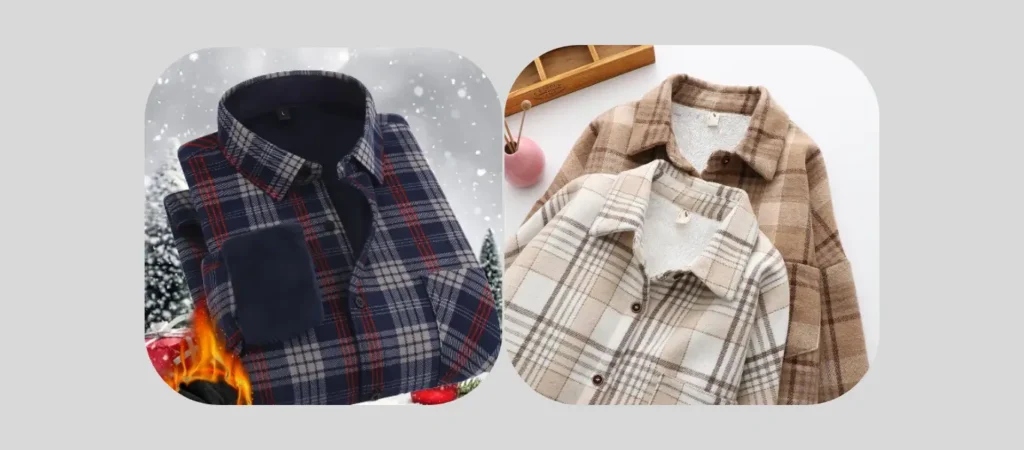
Conclusion – From Fabric Innovation to Value Reconstruction
Fabrics for winter shirts are much over the basic keeping warmth function, which have become the comprehensive carriers of technology innovation, sustainable responsibility, and market strategy. Manufacturers need to build the dynamic response mechanism of “Lab data -consumption trends-trade policy”, by double-ply cotton solidifying the core market, flannel capturing fashion trend, and cashmere-cotton blends breaking into the high-end market. Build differentiated competitiveness within China’s ¥115 billion market and the global formal shirt sector valued at $117.2 billion. Recommend conducting quarterly fabric blind tests (inviting 500+ target consumers to participate), directly translating market feedback into R&D parameters to achieve the leap from “manufacturing” to “smart manufacturing.”