Welcome To Contact Us
Response Within 24 hours Guaranteed | Low MOQ from 50 pcs
🔒 100% Privacy Protected. No Spam Guaranteed.
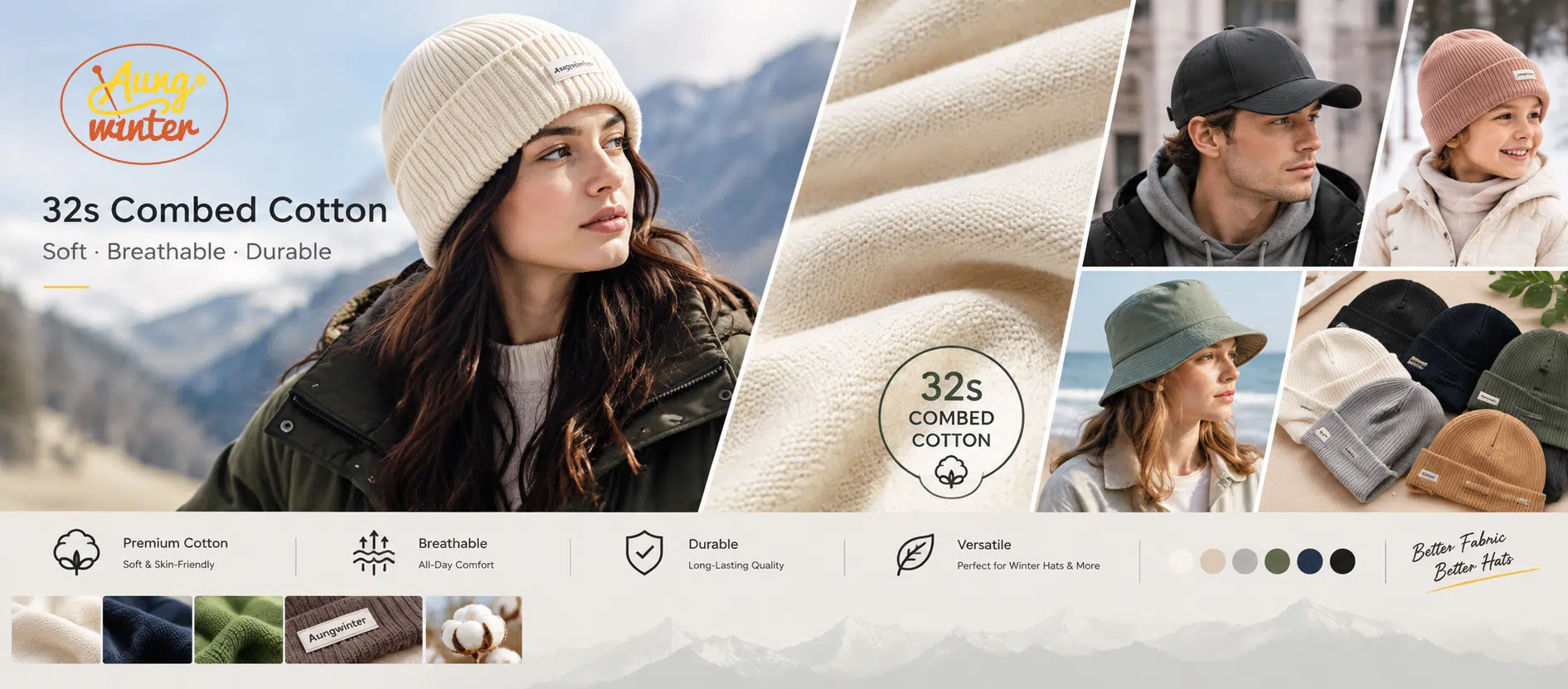
Curated by the Aungwinter Team
As a professional B2B custom headwear manufacturer, Aungwinter knows one thing for sure: fabric is the heart and soul of a hat – it shapes the quality, the repeat purchase rate, and your brand’s reputation. When we help clients develop high-quality cotton hats – think spring/fall casual caps, gentle kids’ hats, premium bucket hats, or the lining of winter hats – 32s combed cotton is the high-value, “top-tier” option we always recommend.
To make material selection easier for brands and buyers, we’ve pulled together the core value and practical application logic of “32s combed cotton,” backed by authoritative industry data.
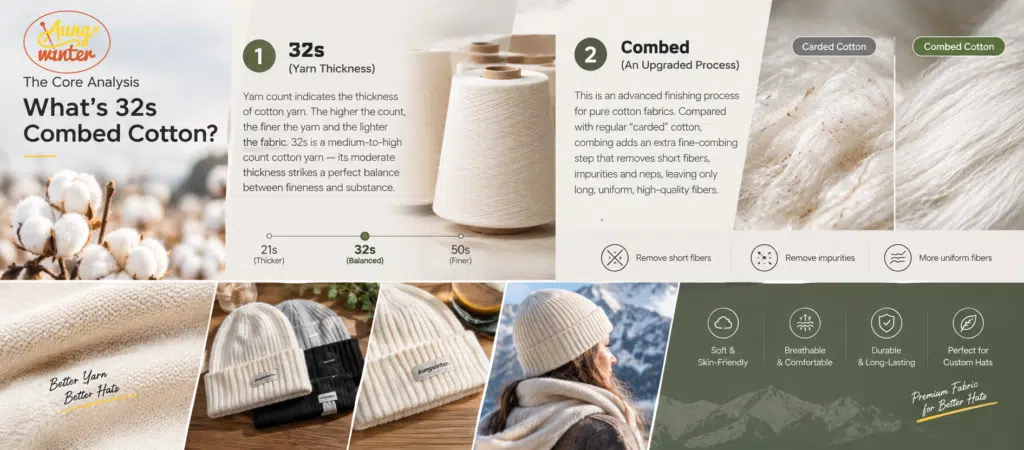
To understand fabric levels and types, you must master two core terms.
1. “32s” (yarn thickness):
Yarn count indicates the thickness of cotton yarn. The higher the count, the finer the yarn and the lighter the fabric. 32s is a medium‑to‑high count cotton yarn – its moderate thickness strikes a perfect balance between fineness and substance. It’s neither as rough and heavy as low-count cotton (such as 21s), nor as thin and delicate as high‑count cotton.
2. “Combed” (an upgraded process):
This is an advanced finishing process for pure cotton fabrics. Compared with regular “carded” cotton, combing adds an extra fine-combing step that removes short fibers, impurities, and neps, leaving only long, uniform, high-quality fibers.
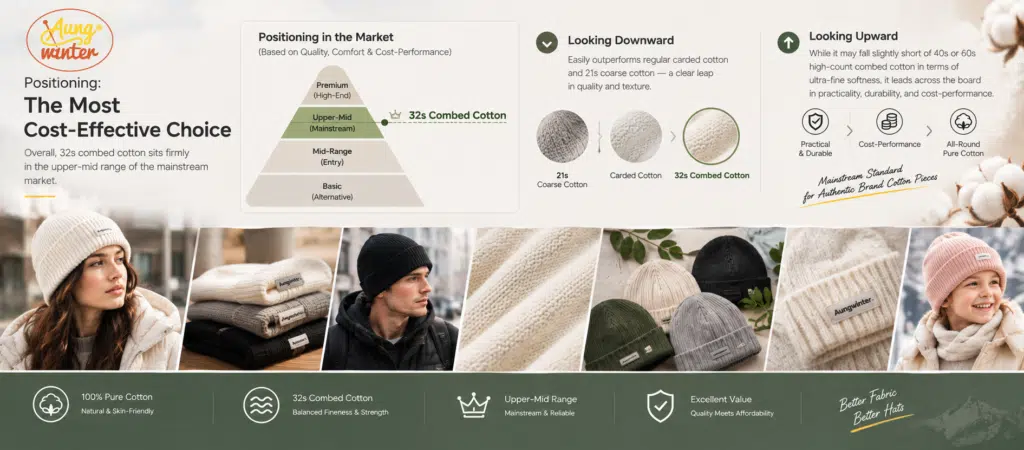
Overall, 32s combed cotton sits firmly in the upper‑mid range of the mainstream market.
Looking downward: It easily outperforms regular carded cotton and 21s coarse cotton – a clear leap in quality and texture.
Looking upward: While it may fall slightly short of 40s or 60s combed cotton in terms of ultra-fine softness, it leads across the board in practicality, durability, and cost-performance. It is widely recognized as an “all-round pure cotton fabric” and a mainstream standard for authentic brand cotton pieces.
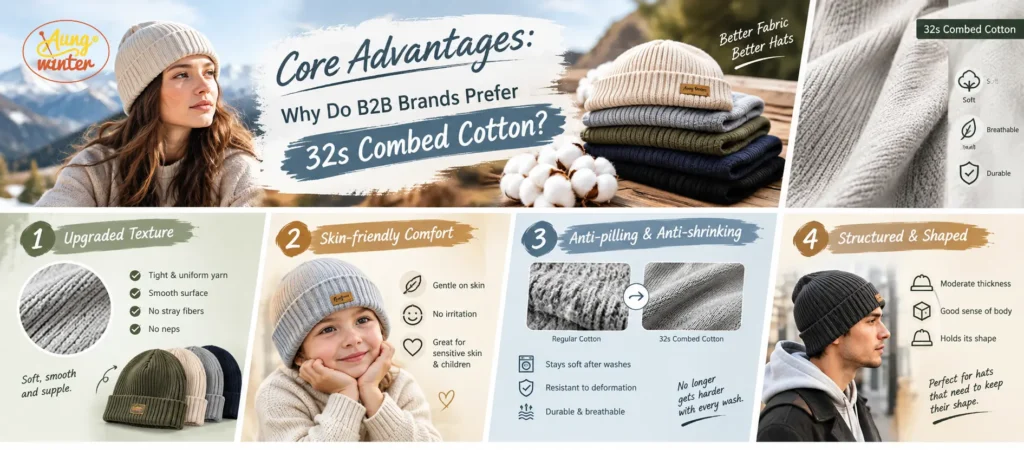
Compared with regular pure cotton – which is prone to pilling, fading, and becoming stiff or misshapen after washing – 32s combed cotton significantly reduces after-sales issues for brand clients. Its advantages are clear:
Choosing by use case is the golden rule of B2B product development. Below is a comparison of 32s combed cotton and premium 40s/60s combed cotton across key dimensions – helping you precisely match your product line.
| Comparison Dimensions | 32s Combed Cotton (We strongly recommend) | Premium 40s/60s Combed Cotton |
| Fabric Physical Properties | Proper yarn thickness. Strikes a perfect balance between fineness and thickness – crisp, structured, and with great body. | Yarns are thinner, lighter, and better lustering, with an extremely soft handfeel. |
| Durability and Care | Durable and easy to care for. Great wear resistance, anti-pilling, shrinkage resistance, and not easy to deform. It stays soft no matter how many times you wash it – no “gets stiffer with every wash” problem here. | It’s on the delicate side. Abrasion resistance is just so-so, and too much washing or friction will wear it down. You’ll need to handle it with care and treat it with professional upkeep. |
| Cost and Value for Money | Talk about value for money. It’s affordable, and the market widely regards it as an “all-rounder” premium fabric – perfect for brands that want to keep costs in check. | Cost more. This is a high-end/light-luxury fabric with a hefty premium, so it works best for products that sell at a higher price point. |
| Regular Market and Scenes | Suitable for everyday wear such as high-end tees, bottoming shirts, sweatshirts, home wear, kids’ clothing, and bedding for all seasons. | Ideal for next-to-skin luxury applications – including high-end luxury bedding, lightweight summer apparel, and premium intimate wear. |
| Custom Hats Recommended by Aungwinter | 1. Spring-autumn casual caps and bucket hats (hold their shape beautifully – no collapsing, even with all-day wear)2. Gentle, skin-friendly kids’ hats (zero neps, built to survive frequent machine washes)3. Winter hat inner lining/spliced panel layer (fixes the itch factor inside winter hats – stays warm, stays breathable) | 1. Limited-edition luxury summer caps (think high-end linen/cotton blend sun hats)2. Light-luxury collaboration hats (built around ultra-gentle skin comfort and premium fabric glow) |
| Final Selection | The optimal all-around solution: the fabric of choice for durability, easy care, comfort, and versatility – delivering outstanding value and fostering strong repeat business. | The premium niche pick: for specific product lines that want that ultra-fine, light-luxury feel – and have the budget and high-end positioning to match. |
Selection Advice from us, Aungwinter: If your brand focuses on high-frequency daily wear, comfort, durability, and value for money, 32s combed cotton is a no-brainer, must-have fabric. If your product line is designed to create high-end, ultra-light, ultra-light-luxury limited-edition pieces, you can selectively introduce 40s/60s combed cotton options. We can provide physical color cards and sample hat comparisons for both fabrics – feel free to request them at any time.
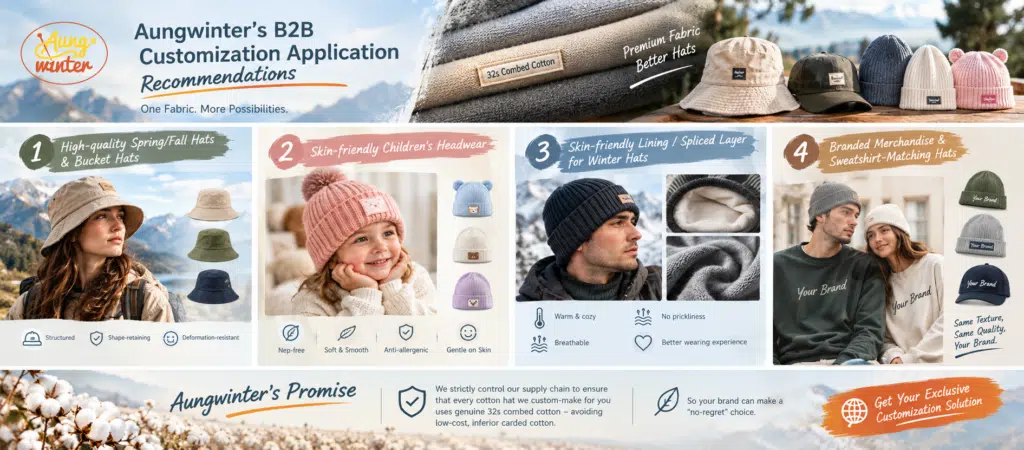
32s combed cotton is common in apparel (T-shirts, sweatshirts, kids’ wear) and home textiles (bedding, towels). But Aungwinter has found valuable commercial uses for it in custom winter headwear:
Aungwinter’s Promise: We strictly control our supply chain to ensure that every cotton hat we custom-make for you uses genuine 32s combed cotton – avoiding low-cost, inferior carded cotton – so your brand can make a “no-regret” choice. Visit our website to get your exclusive customization solution.
A: Regular pure cotton hats tend to pill over time, lose their brim shape, and turn stiff after washing. However, hats made from 32s combed cotton have a smoother, cleaner surface and retain their softness and original shape even after multiple washes, delivering a noticeably more premium feel.
A: No. 32s is a medium-to-high count with moderate thickness, so it has natural body. Aungwinter adds the right interlining or reinforcement – multi-layer stitching, shaping interlining – to give the hat both cotton softness and a clean, structured shape.
A: The combing process removes short fibers and impurities, resulting in a fabric that is nep-free, non-irritating, pill-resistant, and able to withstand repeated washing. For children – who have delicate skin, are highly active, and require frequent laundering – this offers the best balance of safety and comfort.
A: The core advantages are overall cost-performance and durability. Highs cotton costs more and is relatively delicate, with weaker abrasion resistance. By contrast, 32s combed cotton is more cost-effective, more abrasion-resistant, and more washable – making it ideal for brands to launch as a high-frequency volume driver or core style.
A: Since 32s combed cotton is primarily known for breathability and skin-friendliness, a single layer offers limited warmth. In winter hat lines, Aungwinter generally recommends using it as the lining layer or spliced panel layer – the part that touches the skin – to provide an ultra-gentle next-to-skin feel. The outer layer can then be paired with fleece, corduroy, or windproof fabrics to achieve the perfect combination of function and comfort.
A: Combed cotton itself has better shrinkage resistance than carded cotton. At Aungwinter, we use mature pre-shrinking treatments and eco-friendly reactive dyeing processes during garment washing and dyeing. This further keeps shrinkage rates and colorfastness within national standards – or even better.
A: We maintain a strict supply chain audit system. Beyond requiring suppliers to provide fabric composition and process testing reports, our quality control team conducts incoming inspections using burn tests, yarn strength tests, and microscopic fiber length observation, preventing inferior materials from being passed off as quality ones.
A: 32s combed cotton has a smooth, clean surface and works beautifully with a wide range of techniques. We support high-precision computerized embroidery (recommended for a more premium look), screen printing, digital direct-to-garment (DTG) printing, and heat transfer printing. Our technical team will recommend the best process combination based on your design to best showcase the fabric’s texture.
A: As a professional B2B custom manufacturer, Aungwinter offers flexible cooperation models. For standard styles, the MOQ is typically 50 pieces per color (depending on the complexity of the craftsmanship). Once samples and fabrics are confirmed, bulk production lead time is generally 15-30 days. Feel free to contact our customer service team for an accurate quote.
A: You can reach us through the “Contact” page on our official website, or send an email directly to our business email address. Please provide:
① Your target style (or a reference image)
② Estimated quantity
③ Special process requirements (such as embroidery or custom care labels)
Our professional team will provide a detailed fabric solution and quotation within 24 hours.
This article was compiled and published by the Fabric Sourcing Center of Aungwinter, dedicated to providing professional, transparent, and high-value custom headwear solutions for brand clients.