Welcome To Contact Us
Response Within 24 hours Guaranteed | Low MOQ from 50 pcs
🔒 100% Privacy Protected. No Spam Guaranteed.

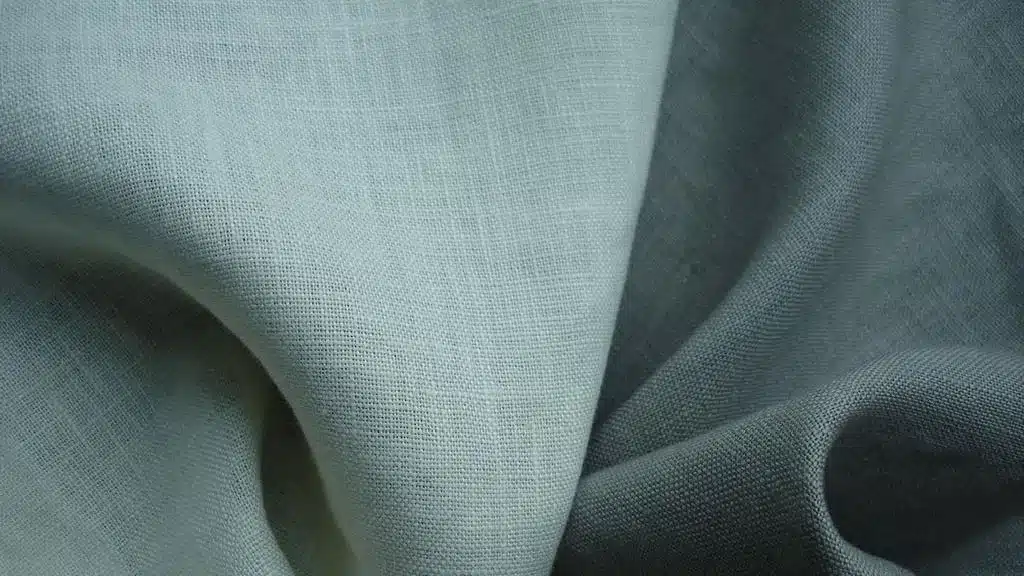
When yarns bend during the weaving process, their length or width within the fabric is necessarily less than their original straight length. The percentage reflecting this difference is called weaving shrinkage, or simply weaving shrinkage. It is expressed as warp shrinkage and weft shrinkage, respectively.
Weaving yarn is a single material. Before the warp and weft yarns are interwoven into a fabric, they can be in a straight state under a certain tension. However, during weaving, the warp and weft yarns interweave and float, and the yarn changes from its original straight state to a wavy and bent state, shortening its length. This results in fabrics with different structures, making the length of the woven fabric shorter than the original length of the yarn, thus causing weaving shrinkage.
The fundamental cause of shrinkage is the crimping of warp and weft yarns. The main factors determining the shrinkage rate of yarns in a fabric are the number of interlacing times of the warp and weft yarns and the degree of crimping wave height.
Weaving shrinkage affects the strength, thickness, density, weight, appearance, and shrinkage rate of the finished product. Due to differences in the fineness and density of the warp and weft yarns, as well as the fabric structure and weaving process parameters, there are various possible combinations between the warp and weft yarns, resulting in different weaving shrinkage rates.
A higher fabric shrinkage rate requires more raw materials, and vice versa.
The method for determining and calculating shrinkage rate is generally to take a fabric sample of a certain length and width, gently separate the warp and weft yarns, and measure and calculate according to the above definition. Alternatively, it can be obtained by using empirical formulas based on relevant parameters of the weaving process.
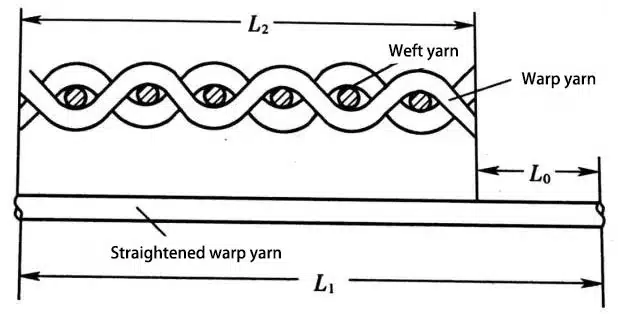

In the formula: a—warp yarn shrinkage rate;
      L1 — Warp length after straightening (i.e., the original length);

      L2 — Warp length of the fabric sample.
For example:
A fabric sample has a warp length of 22cm. Two warp yarns are removed from the sample, straightened, and their lengths are measured. One yarn is 23.4cm long, and the other is 23.6cm long. Calculate the warp shrinkage rate of the fabric sample. (For accuracy, a higher yarn count can be used, generally 10 yarns.)
According to the above formula: L 2 = 22cm
                  L1 = (23.4 + 23.6) / 2 = 23.5cm

                  a=(23.5-22)/23.5*100%=6.38%
The warp shrinkage rate of this fabric sample is 6.38%.
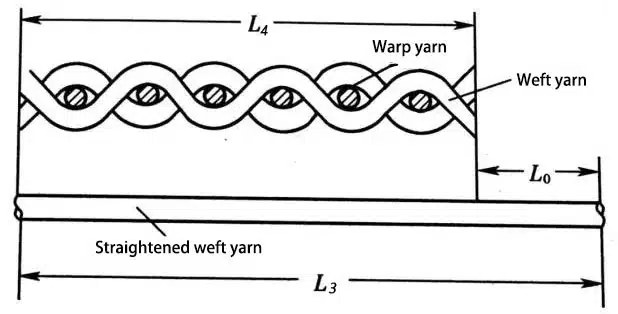
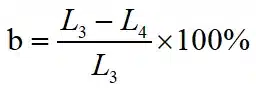
In the formula: b—weft yarn shrinkage rate;
      L3 — Length of the weft yarn after straightening:

      L4 — Weft yarn length of the fabric sample.
For example:
The weft length of the fabric sample is 25.5cm. Two weft yarns are removed from the fabric sample, straightened, and their lengths are measured. One yarn is 27cm long, and the other is 27.2cm long. Calculate the weft shrinkage rate of the fabric sample.
According to the above formula:
                L4 = 25.5cm

                L3 = (27 + 27.2) / 2 = 27.1 cm

                b=(27.1-25.5)/27.1 *100%=5.9%
The weft shrinkage rate of this fabric sample is 5.9%.
The influence of fiber raw materials on shrinkage rate is complex. Generally speaking, yarns that are easy to bend have a large shrinkage rate, while yarns that are easy to undergo plastic deformation have a small shrinkage rate.
When warp and weft yarns of different linear densities interweave, the higher the linear density, the less likely the yarn is to bend and the smaller the weaving shrinkage. Among fabrics with the same warp and weft yarn density, fabrics with high linear density yarns have a larger weaving shrinkage.
High twist results in a tight yarn structure and high stiffness, leading to poor shrinkage performance and low shrinkage rate; conversely, low twist results in a higher shrinkage rate.
The more interlacing points a fabric has, the smaller the average float length, the more crimp waves there are in the warp and weft yarns, and the greater the weaving shrinkage.
The tighter the fabric, the more crimp waves there are in the warp and weft yarns, and the greater the fabric shrinkage.
On-machine tension and shedding time: On-machine tension and shedding time directly affect fabric shrinkage and weft density. High on-machine tension and early shedding time result in small warp yarn crimping, thus reducing warp shrinkage while increasing weft shrinkage; conversely, low on-machine tension makes the warp yarns more prone to crimping, resulting in large warp shrinkage while decreasing weft shrinkage.
Sizing: A higher sizing rate on the warp yarn results in a lower warp yarn shrinkage rate, and vice versa.
Temperature and humidity: When the temperature and humidity in the weaving workshop are high, the warp yarns are more likely to stretch under tension, so the shrinkage decreases and the shrinkage increases; conversely, the warp shrinkage increases and the weft shrinkage decreases.